Kdo chodil s Jane Digby?
Ludvík I. Bavorský datováno Jane Digby od ? do ?. Věkový rozdíl byl 20 roky, 7 měsíců a 9 dny.
Christodoulos Hatzipetros datováno Jane Digby od ? do ?.
Ota I. Řecký datováno Jane Digby od ? do ?. Věkový rozdíl byl 8 roky, 1 měsíců a 29 dny.
Jane Digby

Jane Elizabeth Digby (3 April 1807 – 11 August 1881) was an English aristocrat, famed for her remarkable love life and lifestyle. She had four husbands and many lovers, including Lord Ellenborough, Governor-General of India, King Ludwig I of Bavaria and his son King Otto of Greece, Bohemian nobleman and Austrian statesman Prince Felix zu Schwarzenberg, and the Greek general Christodoulos Hatzipetros. She died in Damascus, then part of the Ottoman Empire, as the wife of Arab sheikh Medjuel el Mezrab, who was 20 years her junior.
Přečtěte si více...Ludvík I. Bavorský

Ludwig I or Louis I (German: Ludwig I.; 25 August 1786 – 29 February 1868) was King of Bavaria from 1825 until the 1848 revolutions in the German states. When he was crown prince, he was involved in the Napoleonic Wars. As king, he encouraged Bavaria's industrialization, initiating the Ludwig Canal between the rivers Main and the Danube. In 1835, the first German railway was constructed in his domain, between Fürth and Nuremberg, with his Bavaria joining the Zollverein economic union in 1834. After the July Revolution of 1830 in France, Ludwig's previous liberal policy became increasingly repressive; in 1844, Ludwig was confronted during the Beer riots in Bavaria. During the revolutions of 1848 he faced increasing protests and demonstrations by students and the middle classes. On 20 March 1848, he abdicated in favour of his eldest son, Maximilian.
Ludwig lived another 20 years after his abdication and remained influential. An admirer of ancient Greece and the Italian Renaissance, he patronized the arts and commissioned several neoclassical buildings, especially in Munich. He was an avid collector of arts, amassing paintings from the Early German and Early Dutch periods as well as Graeco-Roman sculptures.
All living legitimate agnatic members of the House of Wittelsbach descend from him.
Přečtěte si více...Jane Digby
Christodoulos Hatzipetros
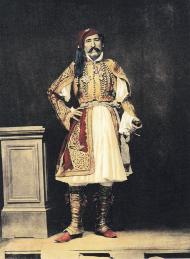
Christodoulos Hatzipetros (Greek: Χριστόδουλος Χατζηπέτρος, 10 May 1799 – 29 October 1869) was a Greek military leader during the Greek War of Independence, who became a general and adjutant to King Otto of Greece after Independence.
Přečtěte si více...Jane Digby
Ota I. Řecký

Ota I. (plným jménem německy Otto Friedrich Ludwig von Wittelsbach, řecky Όθων, Βασιλεύς της Ελλάδος; 1. června 1815 – 26. července 1867) byl první moderní král Řeckého království, dosazený roku 1832 na řecký trůn na základě rozhodnutí Velké Británie, Francie a Ruska.
Přečtěte si více...