Kdo chodil s Elagabalus?
Elagabalus
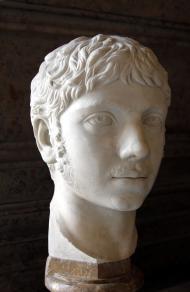
Marcus Aurelius Antoninus (born Sextus Varius Avitus Bassianus, c. 204 – 13 March 222), better known by his posthumous nicknames Elagabalus ( EL-ə-GAB-ə-ləs) and Heliogabalus ( HEE-lee-ə-, -lee-oh-), was Roman emperor from 218 to 222, while he was still a teenager. His short reign was notorious for religious controversy and alleged sexual debauchery. A close relative to the Severan dynasty, he came from a prominent Syrian Arab family in Emesa (Homs), Syria, where he served as the head priest of the sun god Elagabal from a young age. After the death of his cousin, the emperor Caracalla, Elagabalus was raised to the Principate at 14 years of age in an army revolt instigated by his grandmother Julia Maesa against Caracalla's short-lived successor, Macrinus. He only posthumously became known by the Latinised name of his god.
Elagabalus is largely known from accounts by the contemporary senator Cassius Dio who was hostile to him, Herodian, who likely relied extensively on Dio, and the much later Historia Augusta. The reliability of the accounts of Cassius Dio and the Historia Augusta, particularly their most salacious elements, has been questioned. Elagabalus showed a disregard for Roman religious traditions. He brought the cult of Elagabal (including the large baetyl stone that represented the god) to Rome, making it a prominent part of religious life in the city. He forced leading members of Rome's government to participate in religious rites celebrating this deity, presiding over them in person. According to the accounts of Cassius Dio and the Augusta, he married four women, including a Vestal Virgin, in addition to lavishing favours on male courtiers they suggested to have been his lovers, and prostituted himself. His behaviour estranged the Praetorian Guard, the Senate, and the common people alike. Amidst growing opposition, at just 18 years of age he was assassinated and replaced by his cousin Severus Alexander in March 222. The assassination plot against Elagabalus was devised by Julia Maesa and carried out by disaffected members of the Praetorian Guard.
Elagabalus developed a posthumous reputation for extreme eccentricity, decadence, zealotry, and sexual promiscuity. Among writers of the early modern age, he endured one of the worst reputations among Roman emperors. Edward Gibbon, notably, wrote that Elagabalus "abandoned himself to the grossest pleasures with ungoverned fury". According to Barthold Georg Niebuhr, "the name of Elagabalus is branded in history above all others; [...] "Elagabalus had nothing at all to make up for his vices, which are of such a kind that it is too disgusting even to allude to them". An example of a modern historian's assessment is Adrian Goldsworthy's: "Elagabalus was not a tyrant, but he was an incompetent, probably the least able emperor Rome had ever had". Despite near-universal condemnation of his reign, some scholars write warmly about his religious innovations, including the 6th-century Byzantine chronicler John Malalas, as well as Warwick Ball, a modern historian who described him as "a tragic enigma lost behind centuries of prejudice".
Modern scholars have questioned the accuracy of Roman accounts of his reign, with suggestions that the reports of his salacious behaviour and sexual excess likely reflected a desire to politically discredit him in the immediate aftermath of his death, as well as reflecting Roman stereotypes regarding people from the Orient as effeminate.
Přečtěte si více...Zoticus
Aurelius Zoticus (Greek: Αύρήλιος Ζωτικός; active c. 219 – 221) was a cubicularius and famous male lover of the young Roman emperor Elagabalus.
His story is known in two versions, one told by Cassius Dio and one contained in the later Historia Augusta.
Přečtěte si více...Elagabalus
Hierocles
Hierocles (Greek: Ἱεροκλῆς, late 2nd century – 222 AD) was a favourite and lover of the Roman Emperor Elagabalus.
Most of the descriptions of his life are given by Cassius Dio and the Historia Augusta. Hierocles was from Caria in Anatolia, and was at some point enslaved, later becoming a charioteer in the service of Elagabalus. Initially, he was a lover and student of another charioteer named Gordius.
Elagabalus was said to have been captivated by the blond and youthful Hierocles when the athlete fell in front of him during a chariot race. The Emperor made him his lover and husband and, as a consequence, Hierocles was alleged to have gained significant political influence, allegedly having more power than the emperor himself.
Additionally, Hierocles' mother, a slave, was promoted to be equal among wives of ex-consuls. Hierocles is said to have drugged the athlete Aurelius Zoticus with a drug that "abated the other's manly prowess." After Zoticus was unable to secure an erection, Elagabalus had him exiled from Rome. This later saved the athlete's life as he was not executed with the members of the court in 222.
After Elagabalus granted Hierocles his freedom, he wanted Hierocles to be declared caesar, against the opposition of his grandmother, Julia Maesa. Allegedly, Elagabalus' partiality towards Hierocles, coupled with his eccentricities, such as delighting in being physically reprimanded by him, were the principal reasons he lost the support of the Praetorian Guard, which led to his death.
Elagabalus, when threatened with death by the Praetorian Guard, reported to have said, "Grant me this one man, whatever you may have been pleased to suspect about him, or else slay me," in regards to Hierocles. This postponed his assassination to 222 AD, after which Hierocles and many other members of the emperor's court, including Elagabalus's mother Julia Soaemias, were also killed.
Přečtěte si více...