Kdo chodil s Alexandr Veliký?
Cleophis datováno Alexandr Veliký od ? do ?.
Barsína datováno Alexandr Veliký od ? do ?.
Bagoas datováno Alexandr Veliký od ? do ?.
Hefaistión datováno Alexandr Veliký od ? do ?.
Campaspe datováno Alexandr Veliký od ? do ?.
Alexandr Veliký

Alexandr Veliký (20. nebo 21. července 356 př. n. l. Pella – 10. nebo 11. června 323 př. n. l. Babylón), také známý jako Alexandr III. Makedonský (řecky Μέγας Αλέξανδρος (ο Μακεδών ο Τρίτος), [Megás Alexandros (ho Makedón; ho Trítos)]), byl král (basileús) Makedonie. Alexandr rozšířil hranice své říše tažením do Persie a na indický subkontinent, díky čemuž se stal zřejmě největším a nejúspěšnějším vojevůdcem celé historie, který neprohrál žádnou bitvu. V době své smrti ovládal většinu světa známého tehdejším Řekům.
Poté, co si Alexandrův otec král Filip II. Makedonský podmanil řecké městské státy, vydal se Alexandr na východ proti obrovité perské říši Achaimenovců. Během jedenácti let nepřetržitých vojenských kampaní Alexandr postupně dobyl Anatolii, Sýrii, Fénicii, Judeu, Egypt, Mezopotámii, Írán a Střední Asii. Teprve ve vzdálené Indii ho vlastní vojáci donutili upustit od úmyslu dosáhnout velkého vnějšího moře. Po návratu do Babylonu se chystal k dalším výbojům na Arabský poloostrov, odkud chtěl vést své muže na západ. Těmto smělým plánům však zabránil jeho předčasný skon.
V Alexandrem podrobených zemích v následujících staletích probíhala řecká kolonizace a jejich osídlování. Tím započala epocha helénismu, která představovala kombinaci řeckých a orientálních kulturních vlivů. Alexandr již za života (a především po smrti) inspiroval mnohé jedince k literárnímu zachycení a oslavě výjimečných činů, jichž dosáhl. Alexandrova postava proto hluboce pronikla do dějin a mýtů nejen řecké kultury, ale i těch východních.
Je po něm pojmenován rozpadlý kráter Alexander na přivrácené straně Měsíce.
Přečtěte si více...Cleophis
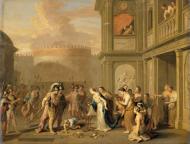
Cleophis (Sanskrit: Kripa ) was an Assacani queen and key figure in the war between the Assacani people and Alexander the Great. Cleophis was the mother of Assacanus, the Assacanis' war-leader at the time of Alexander's invasion in 326 BCE. After her son's death in battle, Cleophis assumed command and negotiated a settlement that allowed her to retain her status. Later accounts claim Cleophis had a son by Alexander, a notion dismissed by historians.
The Assacani (called Ashvakas in Sanskrit, from the word Ashva, meaning "horse") were an independent people who lived in parts of the Swat and Buner valleys in ancient Gandhara. These highlanders were rebellious, fiercely independent clans who resisted subjugation.
Přečtěte si více...Alexandr Veliký
Barsína
Barsine (Greek: Βαρσίνη; c. 363–309 BC) was the daughter of a Persian father, Artabazus, satrap of Hellespontine Phrygia, and a Greek Rhodian mother, the sister of mercenaries Mentor of Rhodes and Memnon of Rhodes. Barsine became the wife of her uncle Mentor, and after his death married her second uncle, Memnon.
In 334 BC, the year of Alexander's invasion of Asia, she and her children were sent by Memnon to the king Darius III as hostages for his fidelity; and in the ensuing year, when Damascus was betrayed to the Macedonians, she fell into the hands of Alexander, by whom it is said that she became the mother of Heracles.
Twelve years after Alexander's death in 323 BC, Barsine's son-in-law Nearchus unsuccessfully advocated for Heracles' claim to the throne, who was then seventeen, having been born about five years after Barsine and Alexander supposedly met in Damascus in 333 BC. From a comparison of the accounts of Diodorus and Justin, it appears that he was brought up at Pergamum under his mother's care, and that she shared his fate when in 309 BC Polyperchon was induced by Cassander to murder him. Barsine is sometimes confused with Stateira II, wife of Alexander, who also may have been called "Barsine".
Přečtěte si více...Alexandr Veliký
Bagoas

Bagoas (altpersisch Bagoi; altgriechisch Βαγώας; † nach 324 v. Chr.) war ein Günstling am persischen Königshof und im Gefolge Alexanders des Großen im 4. vorchristlichen Jahrhundert. Er ist nicht zu verwechseln mit dem gleichnamigen Hofminister.
Přečtěte si více...Alexandr Veliký
Hefaistión

Hephaestion (Ancient Greek: Ἡφαιστίων Hēphaistíōn; c. 356 BC – 324 BC), son of Amyntor, was an ancient Macedonian nobleman of probable "Attic or Ionian extraction" and a general in the army of Alexander the Great. He was "by far the dearest of all the king's friends; he had been brought up with Alexander and shared all his secrets." This relationship lasted throughout their lives, and was compared, by others as well as themselves, to that of Achilles and Patroclus.
His military career was distinguished. A member of Alexander the Great's personal bodyguard, he went on to command the Companion cavalry and was entrusted with many other tasks throughout Alexander's ten-year campaign in Asia, including diplomatic missions, the bridging of major rivers, sieges and the foundation of new settlements. Besides being a soldier, engineer and diplomat, he corresponded with the philosophers Aristotle and Xenocrates and actively supported Alexander in his attempts to integrate the Greeks and Persians. Alexander formally made him his second-in-command when he appointed him Chiliarch of the empire. Alexander also made him part of the royal family when he gave him as his bride Drypetis, sister to his own second wife Stateira, both daughters of Darius III of Persia.
When Hephaestion died suddenly at Ecbatana around age thirty-two, Alexander was overwhelmed with grief. He petitioned the oracle at Siwa to grant Hephaestion divine status and thus Hephaestion was honoured as a Divine Hero. Hephaestion was cremated and his ashes taken to Babylon. At the time of his own death a mere eight months later, Alexander was still planning lasting monuments to Hephaestion's memory.
Přečtěte si více...Alexandr Veliký
Campaspe

Campaspe (d'après Claude Élien) ou Pancaspé (d'après Pline l'Ancien (latin : Panscapen) passe pour avoir été une maîtresse d'Alexandre le Grand et le modèle du peintre Apelle. Son existence est probablement une légende, elle est surtout connue par une anecdote apocryphe de Pline l'Ancien qui a été le sujet de nombreuses représentations artistiques.
Přečtěte si více...